Breathing exercisesWhat research says · try it with the orb
Five guided techniques live inside RelaxPlayer. Here is what each one is for, what the studies actually found – and how to design a rhythm of your own.
Slow, structured breathing is one of the simplest ways to nudge the body from alert mode towards rest. Instead of trying to “stop thinking”, you give your attention one concrete job: follow the orb, count the seconds, let the exhale run long.
RelaxPlayer pairs that with soft ambient music, so you can breathe along without silence or a ticking metronome. Pick a technique, press Start and follow the glowing orb – it grows on the inhale, rests on the hold and shrinks on the exhale.
The five techniques in the player
4-7-8 breathing (Dr. Weil)
4 s in · 7 s hold · 8 s out
Breathe in quietly through the nose for 4 seconds, hold for 7 and exhale fully through the mouth for 8. Popularised by Dr. Andrew Weil, it is a favourite for easing anxiety and winding down before sleep. Smaller studies and reviews report better anxiety, sleep quality, blood pressure and heart rate variability, but a large controlled trial like the Stanford sigh study is still missing – a safe, popular technique with reasonable support, not a miracle formula.
Source: scoping review of 4-7-8 breathing, 2025; smaller clinical studies in COPD and sleep disorders.
Box breathing (Navy SEAL method)
4 s in · 4 s hold · 4 s out · 4 s hold
Four equal sides: in, hold, out, hold. Made famous by Navy SEALs and first responders as a way to stay calm and focused under pressure. In the 2023 Stanford trial it improved mood and lowered anxiety, but in a direct comparison it trailed the physiological sigh. An even rhythm is excellent for steady attention during demanding tasks, while a long exhale works stronger in acute stress.
Source: Balban et al., Cell Reports Medicine, 2023.
Coherent (resonance) breathing
5.5 s in · 5.5 s out
Equal, unhurried breaths of about 5.5 seconds – roughly 5–6 breaths a minute. This is the resonance pace behind heart rate variability (HRV) biofeedback. A 2017 study found that 15 minutes at this speed raised the HRV ratio linked to parasympathetic activity and improved mood compared with quiet sitting; reviews add that breathing at about 0.1 Hz makes the heartbeat oscillate in the band tied to the vagus nerve.
Source: Steffen et al., Frontiers in Public Health, 2017; review in Frontiers in Psychology, 2021.
Calm (extended exhale)
4 s in · 6 s out
A short inhale and a longer exhale. A longer out-breath stimulates the vagus nerve and slows the heart, which makes this a quick way to settle after a tense moment – and a gentle starting point if holding your breath feels uncomfortable.
Source: Gerritsen & Band, Frontiers in Human Neuroscience, 2018; Zaccaro et al., 2018.
Physiological sigh
2 s in · 1 s sip · 6 s out
Two inhales through the nose – a long one and a short top-up sip – then one long, slow exhale. In a 2023 Stanford randomised trial with 111 participants, five minutes a day of cyclic sighing for a month gave the biggest mood boost and the largest drop in resting breathing rate of the four practices compared. The difference was visible after a single five-minute session.
Source: Balban et al., Cell Reports Medicine, 2023.
Why a longer exhale works
Calm, 4-7-8 and the sigh all rely on an exhale that is longer than the inhale. Reviews describe how slow breathing with a prolonged exhale stimulates the vagus nerve and activates the parasympathetic branch of the nervous system – the one that slows the body down – instead of the sympathetic “fight or flight” branch. Systematic reviews agree the effect is real and measurable (lower heart rate, higher HRV), although its size depends on the technique, the timing and how long you keep practising.
Breathing and ambient music
Ambient and chillout music without a strong beat does not push your body to match the tempo of the track, so it does not compete with the rhythm the orb sets. It simply forms a soft sound background that helps keep attention on the breath and masks distracting noise. In RelaxPlayer the music keeps playing underneath the breathing exercise – no second tab needed.
Create your own breathing technique
The presets are a starting point. On the BREATHE screen of the player you can build a rhythm that fits you: set the inhale, the hold after inhaling, the exhale and the hold after exhaling in seconds (use 0 to skip a hold) and give it a name. While you tune it, the player shows the cycle length and breaths per minute. Save it and it starts right away and is remembered for next time.
Slower and deeper
Borrow the coherent idea of equal, unhurried breaths: try 5 s in and 5 s out, about 6 breaths a minute.
Longer exhale for the evening
Start from Calm (4 / 6) and lengthen the exhale step by step, for example 4 s in and 8 s out.
A gentler box
Keep the box shape but make it shorter, 3 s per side – or set one hold to 0 for a softer triangle.
Start gently, and if you feel dizzy or uncomfortable, return to normal breathing.
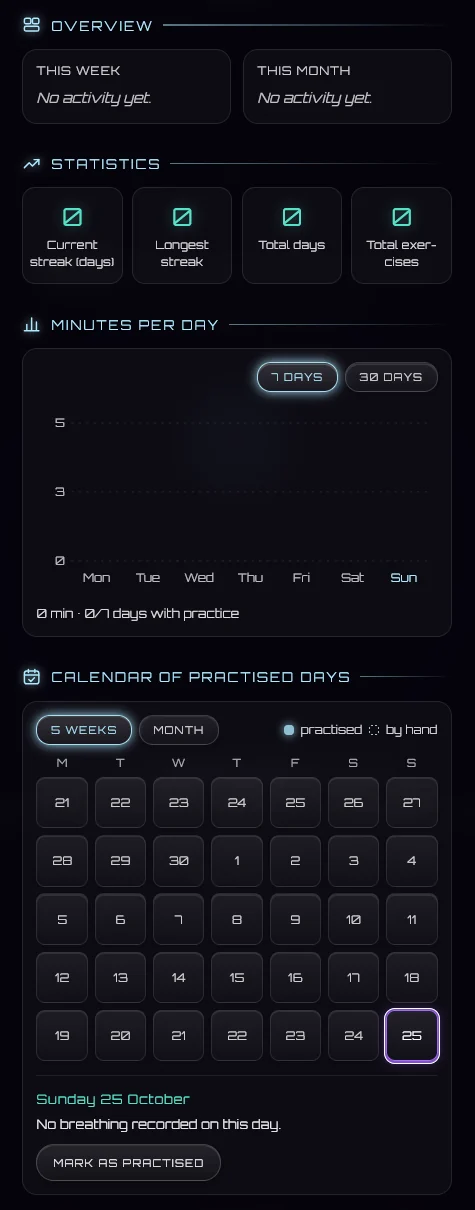
Every finished exercise is saved automatically, so you can see whether breathing is becoming a habit. The breathing screen in the player has its own progress section – no account and no extra setup. A few minutes a day is enough for the numbers to start building up.
Overview, statistics, chart and calendar in the player
Overview
A quick summary of this week and this month, so you see at a glance how much you have practised lately.
Streaks and totals
Your current streak in days, your longest streak, the total number of days you practised and the total number of exercises you completed.
Minutes per day
A bar chart of your breathing time, switchable between the last 7 and 30 days, with a short line underneath: total minutes and how many days included practice.
Calendar of practised days
View the last five weeks or a whole month. Practised days are highlighted; tap any day to see what you did on it.
Mark a day by hand
Breathed without the app, or on another device? Select the day and press “Mark as practised”. Days added this way are shown with a dotted outline, so you can tell them apart.
Your progress is kept in your own browser on this device. Clearing the site data in your browser also clears the statistics.
Frequently asked questions
Which breathing technique is best for stress?
In the 2023 Stanford trial the physiological sigh gave the strongest mood and resting-breathing-rate effect, so it is a good first try for acute stress. For sleep many people prefer 4-7-8 or Calm, and box breathing suits steady focus. Try each for a few minutes and keep the one that feels natural.
How long should I practise?
The Stanford study used five minutes a day and the HRV study above used 15 minutes. Even a few minutes between tasks is a fine start.
Can I create my own technique in RelaxPlayer?
Yes. On the BREATHE screen set the inhale, holds and exhale in seconds, name your technique and save it – it is remembered for next time.
This page is general information, not medical advice. If you have a heart, lung or other health condition, or breath holds make you uneasy, talk to your doctor and skip the holds.
Ready to breathe?
Open the player, pick a technique or create your own, and let the music carry the rest.